

















Category: Tourist Class Lodge
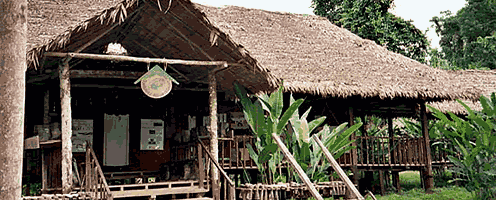

Tambopata Research Center is a spartan yet comfortable 13 bedroom lodge built with the object of lodging tourists and researchers alike and of protecting the adjacent macaw clay lick. Because of its remote location in a Connecticut-sized tract of uninhabited wilderness housing stable populations of endangered wildlife, the small scale of its infrastructure and operations and the presence of researchers and naturalist guides, Tambopata Research Center is an excellent headquarters for in depth explorations of Amazonian nature and wildlife.
Tambopata Research Center is composed of 4 interconnected, thatch-roofed buildings designed after traditional low-impact native architecture providing the creature comforts necessary for enhancing our wilderness experience without compromising authenticity. All buildings and interconnecting passageways are raised on 4 ft. stilts built from palm trunks or hardwoods. The main building is a 33 ft. by 100 ft. platform divided into 13 double rooms.
Each bedroom is furnished with 2 beds draped in mosquito netting, a chair, a night table with a kerosene wind lamp, and a table for luggage and clothing. Each room is also designed to have a permanent, unobstacled view of the forest surrounding the clearing in order to maximize wildlife observation time; the wall looking out into the forest is a waist-high verandah. To the left of the main building a 20 ft. long, roofed passageway connects to the bathrooms containing 4 flush toilets and 4 shower stalls, offering cold water only.
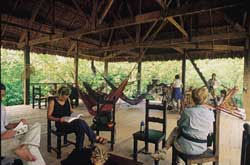
To the right of the main building a 15 ft. long, roofed passageway connects to the dining and meeting room which in turn is connected to the kitchen.
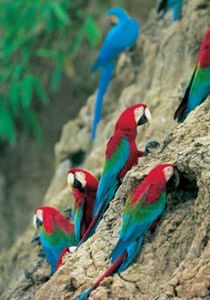
We can provide to the visitors incredible natural history experiences on the macaw clay lick, which is a huge, 50 m. tall cliff of reddish clay that extends for about 500 m. along the west bank of the Tambopata River, and on most clear mornings of the year, and depending on the season, scores and sometimes even hundreds of parrots and macaws flock to the lick. Six species of macaws and nine species of parrots as well as guans, tapir, capybara, howler monkeys and pigeons come to the clay lick to obtain hard to find minerals that are only present in high concentrations on the lick’s soil. Another high quality macaw display and photographic opportunity is found in the palm swamp, where Blue-and-gold and Red-bellied macaws form a nesting colony during breeding season (November to March). There, we have built a 20 m. scaffolding tower for eye-to-eye observation of the breeding couples. For the length of the breeding season, it is possible to climb to the tower, sit in an open platform and shoot photographs of nesting Blue-and-gold and Red-bellied macaw couples, all less then 20 yards away.
Also the forests around Tambopata Research Center offer excellent probabilities of seeing 3 to 4 of the following species of primates; Brown Capuchin, Squirrel, Dusky Titi, Red Howler Monkeys and Saddleback Tamarins. Although they are also present, Spider Monkeys are seen less frequently. Additionally, Tayra and Agouti are seen almost daily around the Tambopata Research Center clearing and large, endangered mammals such as Collared and White-lipped Peccary and Tapir are seen infrequently (Tapir is seen recurrently from the beach in front of the clay lick where one or more individuals cross the river along their trails about 50 yards to the south of the clay lick it is seen by about 1 in 10 of our groups).


Wellness & Health Travel and Tours
A round Peru and Latin America tours specifically created for those who need to recharge their physical and mental energies. A nurturing and enlivening...
Private Jet Charters in Peru and Latin America (View here)

- Christmas in Galapagos & Ecuador Travel
- 2026-27 Christmas in Galapagos & Peru New Year Tour
- 2026-27 Christmas in Galapagos & New Year's in Brazil
- Christmas in Peru and Machu Picchu 2026/2027 - View all
- Christmas Brazil Amazon Cruise
- Christmas Vacations in Costa Rica
- Christmas and New Year in Ecuador & Galapagos Islands
- Christmas and New Year in Chile
- Christmas Vacations in Argentina
- 2026 Christmas Peru and Galapagos Tour
- 2026 Christmas Peru and New Year's Galapagos Tour
- Mexico Christmas and New Year
- New Year's in Peru 2026/2027
- New Year's in Brazil
- Christmas Brazil Tour: Iguazu Falls, Amazon River Cruise from Manaus
- Christmas and New Year's in Latin America 2026/2027
- Brazil & Peru Christmas Highlights Tour - 15 days
- Christmas in Antarctica
- Christmas in the Sun & Beaches
- Winter Christmas & Ski Holidays
- Christmas Cruises
- New Year Getaways


Incl. Miraflores Park, Monasterio & Sanctuary Lodge Hotels, all trains, all private tours, finest service guaranteed





Adan
USA
11th November 2026

Theresa W.
SINGAPORE
9th November 2026

- Ultra Luxury-Luxury Retreat Collection
- Luxury Travel Peru
- Luxury Travel Argentina
- Luxury Travel Brazil
- Luxury Travel Chile
- Luxury Caribbean Trips
- Luxury Travel Galapagos
- Luxury Travel Ecuador
- Luxury Travel Machu Picchu
- Luxury Travel Patagonia
- Luxury Travel Iguassu Falls
- Luxury Travel Mexico
- Luxury Travel Guyana
- Luxury Travel Costa Rica
- Luxury Travel Antarctica
- Luxury Travel Panama
- Luxury Travel Peru & Brazil
- Luxury Travel Peru & ecuador
- Luxury Travel Peru & Costa Rica
- Luxury Travel Peru & Mexico
- Luxury Travel Cuba

Free Cuzco & Machu Picchu Travel Guide
Cusco Tours & Travel Packages
Trekking Tours around Cusco
Cusco Hotels
Cusco Restaurants
Cusco Churches
Cusco Museums
Cusco Archeological sites
About Cusco History
Cusco Food and Drink
Sacred Valley of the Incas
Watch our Inca Trail - Videos here
Watch our Gourmet Tour - Video here
- Peru tours, travel & vacations
- Galapagos tours & cruises
- Ecuador tours, travel & vacations
- Chile tours, travel & vacations
- Brazil tours, travel & vacations
- Bolivia tours, travel & vacations
- Argentina tours, travel & vacations
- Surinam tours, travel & vacations
- Venezuela tours, travel & vacations
- Mexico tours, travel & vacations
- Honduras tours, travel & vacations
- Costa Rica tours, travel & vacations
- Cuba tours, travel & vacations
- Panama tours, travel & vacations
- Paraguay tours, travel & vacations
- Tahiti tours, travel & vacations
- Guyana tours, travel & vacations
- Bora Bora tours, travel & vacations
- Antarctica tours, travel & vacations
- Luxury Caribbean tours, travel & vacations

Private jet & helicopter charters throughout Peru and Latin America.

AMAZING PHILANTHROPY
Helping children in one of Peru's poorest village schools supporting hands-on initiatives such as implementation of classrooms to ensuring the robust education, health, and well-being of young children

AMAZING PHILANTHROPY
As part of our philanthropic projects we support the older community to promote sporting and social events in the lesser known regions of Peru.




Honoured to include to distinguished clients by providing jet services and luxury travel in Peru and Latin America
- Robert De Niro Hollywood Actor, Producer & Director
- Zygmunt Solorz-Żak Businessman Forbes Top 100 World's Billionaire
- Diana Raab American Author • Poet • Lecturer Educator and Inspirational Speake
For more information to join our Hiram Bingham Club visit The Hiram Bingham Club © by Amazing Peru:
The Hiram Bingham Club is an exclusive circle of our most passionate & loyal guests - like-minded individuals who want to experience the highest standard in authentic ultra-luxury travel. We have the World’s Most Exclusive Experiences. Venture Beyond the Extraordinary.
