

















 Share
Share
The sacred valley of the Incas
(Valle sagrado)
The valley of Urubamba, situated close to Cusco was the agricultural larder of Cuzco in Inca times.
The valley is renowned for its excellent climate, fertile lands and the waters of the sacred river of the Inca, the Vilcanota (in Quechua: sacred or wonderful thing) that, in the town of Urubamba, the river changes its name to the UrubambaRiver.
The "Valle Sagrado" is embraced between the towns of Písac and Ollantaytambo, and has wonderful landscapes where its inhabitants, native of the Quechua ethnic group, conserve many customs, traditions and ancestral rites.
It is an area where you can appreciate the high technological development that the Inca reached in terms of agriculture through the "andenería" systems (platform terraces). These systems are still in use today and show sophisticated designs of hydraulic engineering for irrigation purposes. They were also outstanding adoration centers to the Pachamama (or mother earth).
 Pisac
Pisac
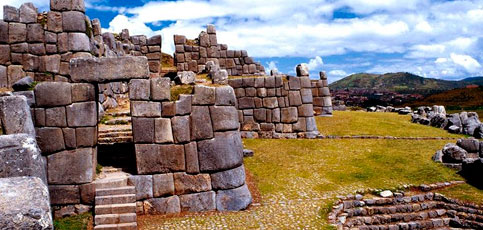
Apicturesque town located on the outskirts of Intihuatana hill (the place where the sun is tied). It has the greatest "andenería" system (platform system) achieved by the Inca in all of the Andes.
Close to the town lies the "Parque Arqueológico de Pisac" (Archaeological Park of Písac), an Inca site whose construction in finely assembled, refined stone, demonstrates a citadel, turrets, military fortresses, and astronomical observatories, etc. The largest Inca cemetery inb the whole of South America is also located here.
Every Sunday, the Sunday feast, headed by the caciques or leaders of Ayllus carry out their "varáyoc" and adorn typical costumes and engage in folkloric dance. They attend a Quechua mass and engage in "catu" or the indigenous fair of agricultural exchange without money passing hands.
In the Main Square every Thursday and Sunday there is a crafts fair, showing beautiful textile crafts, sweaters, ponchos, bags, and showing reproductions of Inca archaeological pieces, the queros (ceremonial glasses), necklaces, etc. To this fair, artisans and indigenous merchants of many towns come to trade their products.
Pisac is located some 32 km (20 miles) from Cusco, at 2972 metres above sea level (9,751 feet).
 Calca
Calca
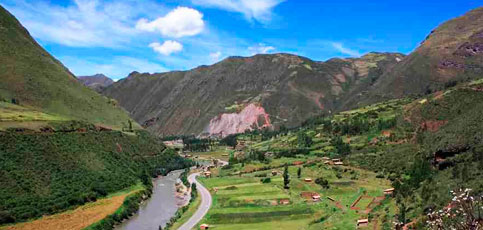
A beautifullytown some 50 km (31 miles) from Cusco, and at an elevation of 2928 metres above sea level (9,606 feet) affording wonderful views of the mountains of Pitusiray and Sahuasiray. Close to the town are the medicinal spas of Machacancha (thermal sulfurous springs) and Minasmoqo. Also close by is the archaeological Inca complex of Huchuy Cusco, perched over a thousand meters over the SacredValley.
 Yucay
Yucay
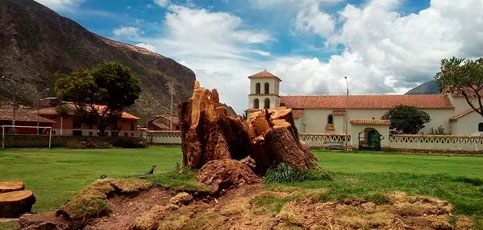
Located some 68 km (42 miles) from Cusco, and at 2857 metres above sea level (9,373 feet), Yucay
was the elected resort for the Inca royalty which also attributes a mythological character and empowerment on the human spirit.
The fertility of its lands transformed it into one of the main centers of agricultural production during the Inca times, with several large "andenerías" (platforms). There are numerous Inca constructions one of the most outstanding among these is the Palace of the Inca Sayri Túpac. This is a stone and adobe construction with beautiful wall decorations. There is also a small museum in the area.
 Urubamba
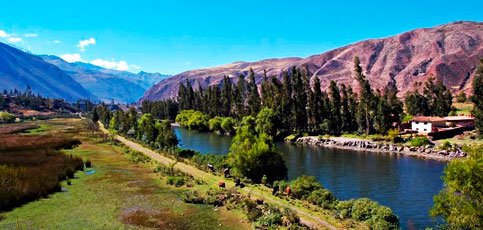
An old Inca town located in the fertile valley of the same name and formerly a great agricultural producing centre of the Inca.
Also known as the "Capital Arqueológica del Perú" (Archaeological Capital of Peru), for its rich Inca archaeological sites it is also called "La Perla del Vilcanota", for the incomparable landscapes that surround it
 Ollantaytambo
Accoriding tolegend, Ollantay (the titan of the Andes) was of plebeian origin, who loved the princess Cusi Coyllor (cheerful star) the daughter of Inca Pachacútec. In disagreement with this love, Pachacútec sent the princess to a house of Virgins from where Ollántay tried to abduct her. He failed without but managed to escape. From the fortress that Ollántay controlled he rebelled against Pachacútec, and after several bloody battles was defeated, but because of the generosity of Pachacútec, he forgave the life of Ollántay.
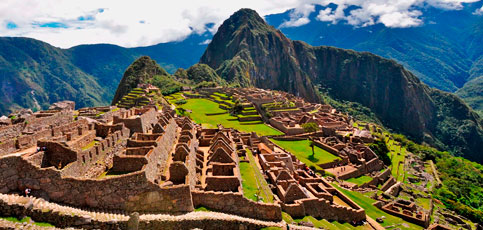
The foundation of Ollantaytambo is attributed to Ollántay, and the military fortress that protected this area of the valley which prevails strategically between two mountains. On the summit of the archaeological complex stands six monoliths of enormous size, assembled with incredible precision, with mysterious engravings of Inca iconography.
The current town of Ollantaytambo has many houses built on the bases of the old Inca towns with local people maintaining their ancestral customs.
The complexity and beauty of these Inca constructions and the contemporary town, along with the immense agricultural complex is considered by many to be one of the most important living museums in the world.
Ollantaytambo is located 97 km (60 miles) from Cusco, at an altitude of 2846 metres above sea level (9,337 feet).

Wellness & Health Travel and Tours
A round Peru and Latin America tours specifically created for those who need to recharge their physical and mental energies. A nurturing and enlivening...
Private Jet Charters in Peru and Latin America (View here)

- Christmas in Galapagos & Ecuador Travel
- 2026-27 Christmas in Galapagos & Peru New Year Tour
- 2026-27 Christmas in Galapagos & New Year's in Brazil
- Christmas in Peru and Machu Picchu 2026/2027 - View all
- Christmas Brazil Amazon Cruise
- Christmas Vacations in Costa Rica
- Christmas and New Year in Ecuador & Galapagos Islands
- Christmas and New Year in Chile
- Christmas Vacations in Argentina
- 2026 Christmas Peru and Galapagos Tour
- 2026 Christmas Peru and New Year's Galapagos Tour
- Mexico Christmas and New Year
- New Year's in Peru 2026/2027
- New Year's in Brazil
- Christmas Brazil Tour: Iguazu Falls, Amazon River Cruise from Manaus
- Christmas and New Year's in Latin America 2026/2027
- Brazil & Peru Christmas Highlights Tour - 15 days
- Christmas in Antarctica
- Christmas in the Sun & Beaches
- Winter Christmas & Ski Holidays
- Christmas Cruises
- New Year Getaways

Incl. Miraflores Park, Monasterio & Sanctuary Lodge Hotels, all trains, all private tours, finest service guaranteed




Adan
USA
11th November 2026

Theresa W.
SINGAPORE
9th November 2026

- Ultra Luxury-Luxury Retreat Collection
- Luxury Travel Peru
- Luxury Travel Argentina
- Luxury Travel Brazil
- Luxury Travel Chile
- Luxury Caribbean Trips
- Luxury Travel Galapagos
- Luxury Travel Ecuador
- Luxury Travel Machu Picchu
- Luxury Travel Patagonia
- Luxury Travel Iguassu Falls
- Luxury Travel Mexico
- Luxury Travel Guyana
- Luxury Travel Costa Rica
- Luxury Travel Antarctica
- Luxury Travel Panama
- Luxury Travel Peru & Brazil
- Luxury Travel Peru & ecuador
- Luxury Travel Peru & Costa Rica
- Luxury Travel Peru & Mexico
- Luxury Travel Cuba
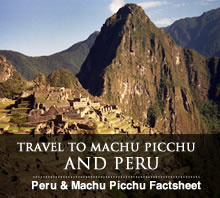


Free Cuzco & Machu Picchu Travel Guide
Cusco Tours & Travel Packages
Trekking Tours around Cusco
Cusco Hotels
Cusco Restaurants
Cusco Churches
Cusco Museums
Cusco Archeological sites
About Cusco History
Cusco Food and Drink
Sacred Valley of the Incas
Watch our Inca Trail - Videos here
Watch our Gourmet Tour - Video here
- Peru tours, travel & vacations
- Galapagos tours & cruises
- Ecuador tours, travel & vacations
- Chile tours, travel & vacations
- Brazil tours, travel & vacations
- Bolivia tours, travel & vacations
- Argentina tours, travel & vacations
- Surinam tours, travel & vacations
- Venezuela tours, travel & vacations
- Mexico tours, travel & vacations
- Honduras tours, travel & vacations
- Costa Rica tours, travel & vacations
- Cuba tours, travel & vacations
- Panama tours, travel & vacations
- Paraguay tours, travel & vacations
- Tahiti tours, travel & vacations
- Guyana tours, travel & vacations
- Bora Bora tours, travel & vacations
- Antarctica tours, travel & vacations
- Luxury Caribbean tours, travel & vacations

Private jet & helicopter charters throughout Peru and Latin America.

AMAZING PHILANTHROPY
Helping children in one of Peru's poorest village schools supporting hands-on initiatives such as implementation of classrooms to ensuring the robust education, health, and well-being of young children

AMAZING PHILANTHROPY
As part of our philanthropic projects we support the older community to promote sporting and social events in the lesser known regions of Peru.




Honoured to include to distinguished clients by providing jet services and luxury travel in Peru and Latin America
- Robert De Niro Hollywood Actor, Producer & Director
- Zygmunt Solorz-Żak Businessman Forbes Top 100 World's Billionaire
- Diana Raab American Author • Poet • Lecturer Educator and Inspirational Speake
For more information to join our Hiram Bingham Club visit The Hiram Bingham Club © by Amazing Peru:
The Hiram Bingham Club is an exclusive circle of our most passionate & loyal guests - like-minded individuals who want to experience the highest standard in authentic ultra-luxury travel. We have the World’s Most Exclusive Experiences. Venture Beyond the Extraordinary.
